
Loading...
Serving Clearwater, FL and surrounding areas. (727) 296-0359
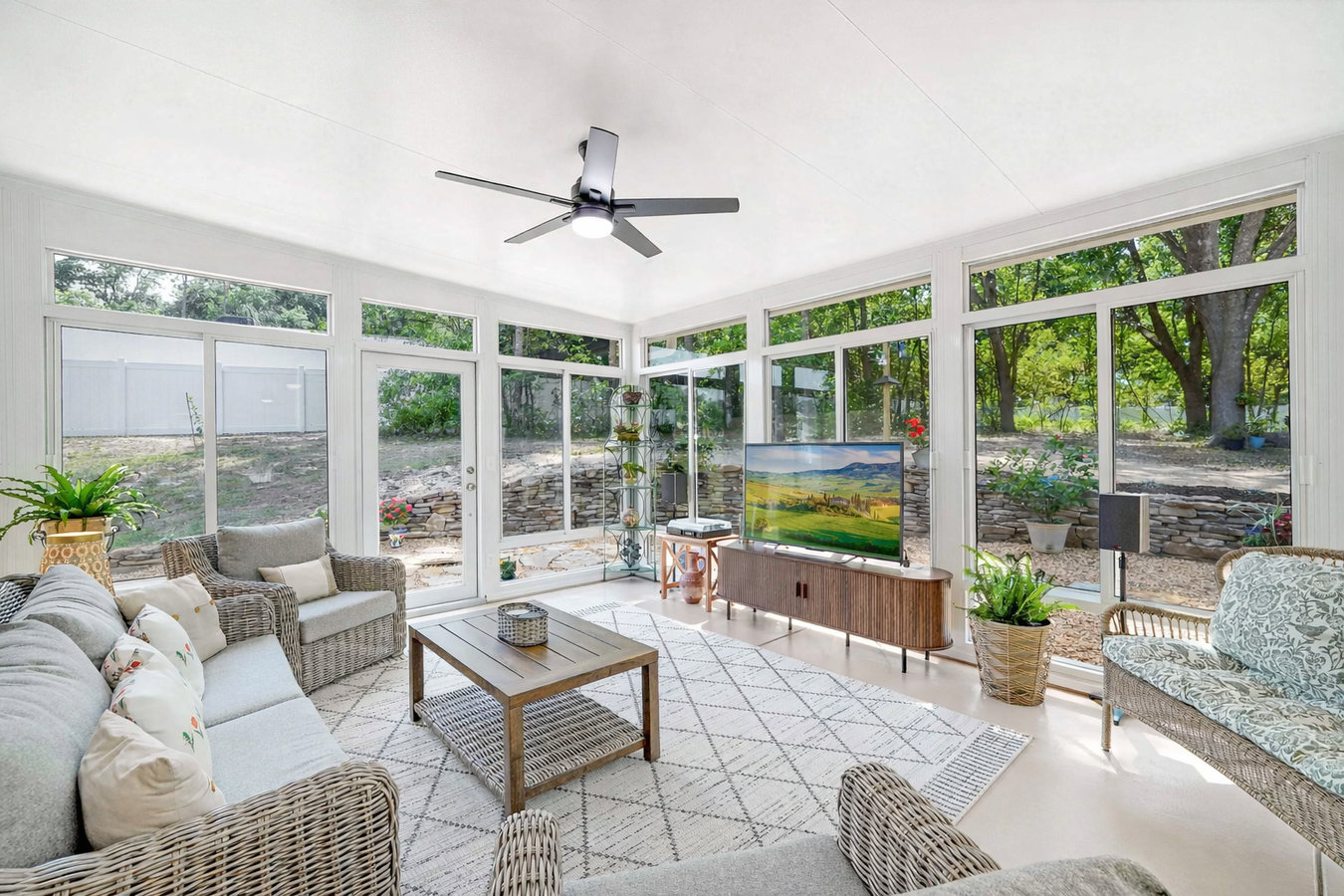
You want more usable space that feels bright and open year-round. A sunroom designed for Clearwater's climate gives you that - without the heat, the bugs, or the storm anxiety.
You want more usable space that feels bright and open year-round. A sunroom designed for Clearwater's climate gives you that - without the heat, the bugs, or the storm anxiety.
Sunroom design in Clearwater, FL is the process of planning a glass-enclosed room addition - choosing the layout, window styles, roof type, flooring, and glass - so the finished space is comfortable year-round, built to Florida's hurricane standards, and permitted through Pinellas County, with most design consultations taking one to three weeks before permit drawings are ready.
A well-designed sunroom is not just a room with a lot of windows. In Clearwater, where summer heat and afternoon storms are facts of life, the design choices made before a single board goes up determine whether the room is genuinely usable in July or just a bright spot that collects dust eight months a year. Your contractor will measure your home's footprint, check where the sun hits your property at different times of day, and work with you on window styles, roof types, and flooring that match both your home's look and Florida's demands. If you are thinking about a room that reflects exactly what you want - not a catalog option - that conversation naturally leads to custom sunrooms as the build path that follows the design phase.
The design phase also covers the permit package. Pinellas County requires detailed drawings before a building permit is issued, and those drawings have to show that the structure meets Florida's wind-load and impact-glass requirements. Getting this right the first time means fewer delays and no back-and-forth with the county that stretches your timeline by weeks.
If your patio or lanai sits empty for most of the year because the heat and bugs make it unbearable, that is the core problem a sunroom solves. Clearwater's summers are genuinely brutal - high heat, high humidity, and afternoon thunderstorms that arrive without much warning. A sunroom with the right glass and cooling lets you enjoy the view and the light without surrendering to the weather, turning a space you avoid into one you use daily.
Screens keep bugs out but do nothing to block Clearwater's intense summer heat or the moisture that makes everything feel damp. If you walk into your screened porch in July and immediately want to walk back inside, you have outgrown what a screen can do for you. A sunroom with heat-blocking glass and a small AC unit transforms that same footprint into somewhere you will actually want to spend time - even in August.
A sunroom costs significantly less than adding a traditional room to your home and goes up faster. If you have been thinking about a reading nook, a home office, or a place to have morning coffee with a view of your yard, a sunroom is often the most practical way to get that space. The key is starting with a design phase that sizes the room correctly for how you plan to use it - not just for how it looks.
After a hurricane season, cracked screens, bent frames, and water-damaged flooring are common on older Clearwater porches. If you are already looking at repairs, it is worth getting a sunroom design consultation at the same time. Converting a damaged structure rather than patching it gives you a result that is built to current Florida wind standards - one that will not need the same repairs after the next storm rolls through.
Every sunroom design project starts with how you want to use the space - dining room, home office, reading room, or plant sanctuary - and works outward from there. We measure your existing home's footprint, check sun angles at different times of day, and help you choose from window styles, roof options, and flooring materials that match both your home's exterior and Florida's practical demands. Whether your goal is a fully enclosed, air-conditioned room or a bright transitional space that connects your interior to your yard, the design phase is where those choices get locked in before anything goes to the county for permits. If you want a room that is fully tailored to your dimensions and preferences, that path leads directly to custom sunrooms - where the build follows the design specification exactly.
We also design for enclosures that expand what you already have. If you have a screen porch or a basic patio cover and want to upgrade it into a year-round room, the design consultation looks at your existing structure and figures out what can be incorporated and what needs to be replaced. Projects that start with an existing slab often move faster and cost less - and the design phase is where we establish that. For homeowners whose primary goal is a bright, glass-heavy room with maximum natural light, we can discuss a vinyl sunroom build as a cost-effective option that follows directly from the design.
Best for homeowners who want a specific layout, custom dimensions, or a design that matches an unusual home footprint or HOA requirement.
Best for homeowners with a screen porch, patio cover, or lanai they want to upgrade into a fully enclosed, climate-controlled room.
Best for homeowners in Clearwater neighborhoods with active HOAs who need drawings and material specifications that meet board approval requirements before permits are pulled.
Best for homeowners who want to understand what is possible within a specific budget before committing to a full design package or contractor agreement.
Clearwater sits on the Gulf Coast in a high-velocity wind zone, which means every sunroom built here must be designed from the start to handle hurricane-force wind pressure. That is not a premium add-on - it is a code requirement enforced by Pinellas County inspectors at every stage of construction. In practical terms, it means your design has to specify impact-resistant glass or hurricane shutter systems, and the entire structure has to be engineered with wind loads in mind. A contractor who uses the same design template they would use in an inland county is not doing the work correctly. The Florida Building Commission sets these standards, and every permit application in Pinellas County is reviewed against them. The other major design factor is heat and humidity. Clearwater averages over 360 days of sunshine per year, and summer humidity regularly tops 80 percent. A sunroom designed without the right glass, insulation, and ventilation will be unusable from May through October - half the year. This is not a minor comfort issue; it determines whether the room is genuinely livable or just a bright space you walk past.
Salt air from the Gulf is another design consideration that most inland contractors overlook. Homes within a few miles of the water are exposed to salt-laden air that accelerates corrosion on metal frames, fasteners, and hardware - which is why the materials specified during the design phase matter so much for long-term performance. Homeowners in Dunedin and Safety Harbor face the same coastal material considerations as Clearwater residents, and our designs account for those conditions in every material selection we recommend.
We will ask a few basic questions - where on your home you are thinking about adding the sunroom, roughly how large you want it, and how you plan to use the space. Most homeowners hear back within one business day. This is not a sales call; it is a quick check to make sure the project is a good fit before we schedule a site visit.
A designer or project manager comes to your home, walks the exterior, and takes measurements. We check where the sun hits your property, how your existing roof and walls are structured, and whether HOA setback rules or utility lines affect the design. You will leave this meeting with a clearer picture of what is possible and a rough sense of cost.
We put together a design proposal with drawings, material options, and a detailed quote. If your neighborhood has an HOA, we help you prepare the submission package. Do not sign a contract or pay a deposit until you have HOA approval in writing - HOA rejections after the fact are expensive and stressful, and we have seen them derail projects that were otherwise ready to go.
Once you sign the contract, we submit the permit application to Pinellas County and keep you updated on status. Construction begins when permits are in hand - typically one to three weeks of active work. Pinellas County inspectors visit at key stages, and we hand you the closed permit paperwork when the final inspection passes. Keep that paperwork; you will want it if you ever sell.
No obligation - just a site visit, a written design proposal, and a clear estimate before you commit to anything.
(727) 296-0359Every design we produce starts with Clearwater's specific conditions - high-wind zone requirements, Gulf Coast salt air, and summer heat that regularly exceeds 90 degrees. These are not upgrades we charge extra for; they are the baseline every design here should meet. A sunroom designed to these standards stays comfortable and holds up structurally in a way that generic designs simply do not.
We manage the permit application, the inspection scheduling, and the permit closeout paperwork on your behalf. You do not have to navigate the county building department yourself or wonder whether the right inspections happened. When the job is done, you get the closed permit documentation in your hands - the same paperwork a future buyer's lender will ask for.
A large share of Clearwater neighborhoods - including Countryside, Feather Sound, and the barrier island communities - are governed by HOAs that require approval before any exterior addition. We know how to prepare a submission package that gets approved the first time, so you are not stuck in a back-and-forth with your board while your project sits on hold. The Pinellas County Property Appraiser records show the permitted addition on your property record after the project closes - important for both insurance and resale value.
We specify frames, fasteners, and hardware rated for coastal environments - not the same components used on inland builds. Salt air from the Gulf moves inland for miles and gets into metal fixtures faster than most homeowners expect. Using coastal-grade materials at the design stage is the difference between a sunroom that still looks good in ten years and one that starts showing rust and frame wear before it has paid for itself.
Every one of those details comes from designing and building in Clearwater's specific environment - not from applying a national template to a local project. When you call us, you get a design process that treats Gulf Coast conditions as the starting point, not an afterthought.
A cost-effective build path for homeowners who want a fully enclosed, glass-heavy room without a fully custom framing package.
Learn MoreTailored construction for homeowners who want specific dimensions, unique layouts, or materials that go beyond standard product lines.
Learn MorePermit slots in Pinellas County fill up - the sooner we submit your application, the sooner you are sitting in your new room.